
Imagine you are running a bank with millions of users across the globe. You can no longer rely on a single central server sitting under your desk — if that server crashes or suffers a power outage, your entire bank goes offline!
To make your bank resilient, you deploy multiple database servers across the world (e.g., US East and Europe West). Now, when a user deposits money in New York, the US server must talk to the Europe server so everyone has the exact same account balance.
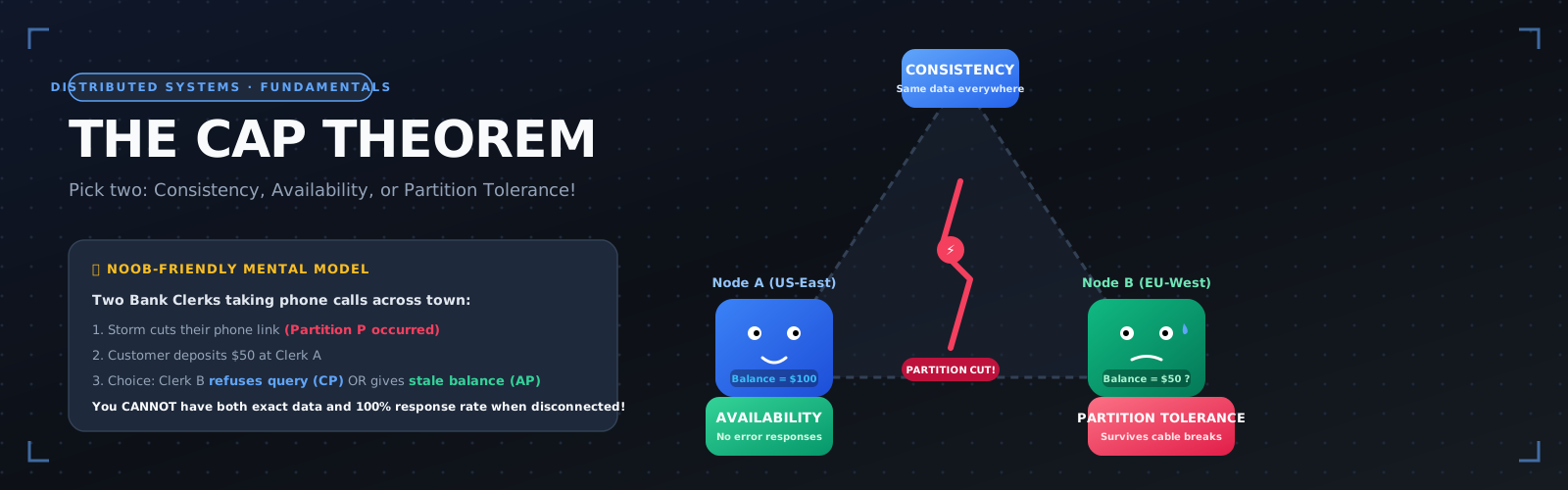
But what happens when a construction crew accidentally cuts the underwater internet cable connecting your US and Europe data centers?
This exact dilemma is captured by one of the most fundamental principles in distributed system architecture: The CAP Theorem.
In this guide, we’ll break down the CAP Theorem from scratch — starting with a simple real-world story, moving to technical definitions, visualizing node partitions, and exploring real-world database choices like MongoDB, Cassandra, and PostgreSQL.
1. Explain Like I’m 5: The Story of Two Bank Tellers
Before touching complex database jargon, let’s understand CAP using a simple story.
Suppose you hire two bank tellers, Alice (in New York) and Bob (in London). Both keep a physical notebook recording customer account balances.
       [ Customer ]                             [ Customer ]
            │                                        │
            ▼                                        ▼
    ┌───────────────┐                        ┌───────────────┐
    │  Teller ALICE │ ◄════ Phone Line ════► │   Teller BOB  │
    │  (New York)   │                        │   (London)    │
    └───────────────┘                        └───────────────┘
The Normal Flow:
- A customer visits Alice in New York and deposits $100.
- Alice writes
$100in her notebook. - Alice immediately calls Bob over the phone line and says: “Hey Bob, customer updated balance to $100.”
- Bob writes
$100in his notebook. - If another customer asks Bob in London 5 seconds later, Bob checks his notebook and accurately answers “$100”.
Everyone is happy! The notebooks match.
The Disaster: A Storm Cuts the Phone Line!
One afternoon, a lightning storm snaps the telephone wire between New York and London. Alice and Bob can no longer talk to each other.
Now, a customer deposits $50 with Alice in New York. Alice records the balance as $150. But she cannot call Bob to tell him about it.
       [ Customer ]                             [ Customer ]
            │                                        │
            ▼                                        ▼
    ┌───────────────┐                        ┌───────────────┐
    │  Teller ALICE │      ⚡ PHONE LINE ⚡  │   Teller BOB  │
    │  (Balance: $150) │   === BROKEN! ===   │ (Balance: $100) │
    └───────────────┘                        └───────────────┘
A minute later, a customer asks Bob in London: “What is my balance?”
Bob faces an impossible dilemma. He has only two options:
❌ Option A: Refuse to Answer (Pick Consistency, Sacrifice Availability)
Bob says: “Our communication line is down. I cannot give you your balance right now to prevent giving you wrong information.”
- Result: You maintained Consistency (Bob didn’t lie), but you ruined Availability (the customer got an error/rejection).
❌ Option B: Answer with Old Data (Pick Availability, Sacrifice Consistency)
Bob says: “Your balance is $100!”
- Result: You maintained Availability (Bob gave an immediate response), but you ruined Consistency (the customer received stale data; the true balance was $150!).
💡 The Core Lesson: When the connection breaks, you physically cannot guarantee both exact consistency and 100% availability at the same time. You MUST choose one!
2. Deconstructing C, A, and P
Formulated by computer scientist Eric Brewer in 2000 and formally proven by Seth Gilbert and Nancy Lynch in 2002, the CAP theorem stands for:
                  ▲  C - CONSISTENCY
                 / \  (Linearizability: Everyone sees the same data)
                /   \
               /  *  \
              /_______\
  A - AVAILABILITY     P - PARTITION TOLERANCE
  (Every request gets   (System keeps working despite
   a valid response)     network cable cuts)
Let’s define each term precisely:
1. Consistency ($C$) — Linearizability
Every read receives the most recent write or an error.
- In a consistent system, once a write is acknowledged by any node, all future reads across all nodes must return that value (or newer).
- Think of it as all database nodes behaving like a single unified machine.
2. Availability ($A$) — No Error Responses
Every non-failing node returns a non-error response for every request.
- The system guarantees that every client request receives a response (not an error message or timeout), though it does not guarantee that the response contains the most recent write.
3. Partition Tolerance ($P$) — Network Communication Failures
The system continues to operate despite arbitrary network drops, delays, or lost messages between nodes.
- A “partition” simply means two or more database servers cannot talk to each other over the network due to router failures, cut fiber optic cables, or network congestion.
3. The Big Misconception: “Pick 2 out of 3”
You will often see simplified articles state: “You can pick any 2 out of C, A, and P.”
This is a myth!
In real-world distributed systems running across networks, Partition Tolerance ($P$) is non-negotiable. Physical networks inevitably drop packets, experience latency spikes, or lose connections. You cannot choose “No Partition Tolerance” unless you run your entire application on a single server (which defeats the point of distributed systems).
Therefore, the real choice boils down to:
When a Partition (P) occurs, do you choose CP or AP?
                ┌──────────────────────────────────────────┐
                ┌──────────────────────────────────────────┐
                │          NETWORK PARTITION (P)           │
                │        Communication Wire Cut!           │
                └────────────────────┬─────────────────────┘
                                     │
                    ┌────────────────┴────────────────┐
                    ▼                                 ▼
         ┌─────────────────────┐           ┌─────────────────────┐
         │     CP SYSTEM       │           │     AP SYSTEM       │
         │ (Consistency First) │           │(Availability First) │
         ├─────────────────────┤           ├─────────────────────┤
         │ • Rejects writes/   │           │ • Accepts reads &   │
         │   reads on partitioned│         │   writes on all nodes│
         │   nodes             │           │ • Syncs data later  │
         │ • Avoids stale data │           │ • May return stale  │
         │ • Sacrifices        │           │   data              │
         │   availability      │           │ • Sacrifices        │
         │                     │           │   consistency       │
         └─────────────────────┘           └─────────────────────┘
4. Deep Dive: CP vs AP in Action
Let’s look at how different system types behave under network partitions.
CP Systems (Consistency + Partition Tolerance)
If a network partition isolates a cluster of nodes, a CP system will block or return an error on nodes that cannot guarantee the latest write.
- Example Use Case: Financial banking ledgers, inventory control for concert ticketing, medical records.
- Trade-Off: Users might see error messages like “Service temporarily unavailable, please try again” during a network glitch, but money will never accidentally duplicate or vanish.
AP Systems (Availability + Partition Tolerance)
If a network partition occurs, an AP system allows every node to keep accepting reads and writes independently.
- Example Use Case: Social media feed likes, DNS resolution, shopping cart additions, messenger read receipts.
- Trade-Off: Users can always post comments or add items to their cart, but two users in different continents might temporarily see different like counts until the network heals (Eventual Consistency).
5. Real-World Database Classification
Here is how popular databases map onto the CAP spectrum depending on their configuration:
| Database | Primary Classification | Behavior During Network Partition |
|---|---|---|
| MongoDB | CP | Uses a single primary node per replica set. If primary loses network majority, it steps down and rejects writes until a new primary is elected. |
| Apache Cassandra | AP (Configurable) | Masterless peer-to-peer architecture. Nodes accept writes independently and resolve conflicts later via timestamp or vector clocks. |
| Amazon DynamoDB | AP (Default) / CP | Offers eventual consistency by default for maximum throughput, but allows strongly consistent reads via query flags. |
| PostgreSQL / MySQL | CP (Sync Replication) | Traditional RDBMS with synchronous master-replica setup refuses commit if replica cannot confirm log write. |
| CockroachDB / Spanner | CP | Uses Raft / Paxos consensus algorithms to enforce strict linearizability across global data centers. |
6. Code Comparison: Tuning Consistency Levels
Many modern distributed databases allow developers to tune CAP behavior per query!
Below are practical code examples in Java, Python, JavaScript, and SQL showing how consistency and availability settings are tuned in real applications:
// Tuning Cassandra's CAP balance per request using ConsistencyLevel

// 1. AP Mode: High availability, low latency (Read from ANY single node)
Statement AP_Query = SimpleStatement.builder("SELECT * FROM users WHERE id = 101")
  .setConsistencyLevel(ConsistencyLevel.ONE) // Returns fast, but might be stale!
  .build();

// 2. CP Mode: High consistency (Read from MAJORITY quorum of nodes)
Statement CP_Query = SimpleStatement.builder("SELECT * FROM users WHERE id = 101")
  .setConsistencyLevel(ConsistencyLevel.QUORUM) // Blocks until N/2 + 1 nodes agree!
.build();const { MongoClient } = require('mongodb');
const client = new MongoClient('mongodb://primary,secondary1,secondary2/db');
async function executeStrictWrite() {
const db = client.db('bank');
// Enforce CP behavior: Write must be acknowledged by majority of nodes
await db.collection('accounts').updateOne(
{ accountId: 'ACC_9921' },
{ $inc: { balance: 500 } },
{
writeConcern: { w: 'majority', wtimeout: 5000 },
readConcern: { level: 'majority' }
}
);
console.log('Transaction safely committed across cluster majority!');
}import boto3
dynamodb = boto3.resource('dynamodb')
table = dynamodb.Table('Orders')
# AP Mode (Eventually Consistent - Default, cheaper & faster)
ap_response = table.get_item(
Key={'order_id': 'ORD-8821'},
ConsistentRead=False
)
# CP Mode (Strongly Consistent - Guarantees latest write)
cp_response = table.get_item(
Key={'order_id': 'ORD-8821'},
ConsistentRead=True
)-- Enforce strict CP behavior in PostgreSQL cluster
-- In postgresql.conf on Primary Node:
synchronous_commit = on -- Wait for WAL to hit standby memory
synchronous_standby_names = 'replica_node_1, replica_node_2'
-- Result: If network to standby drops, Primary blocks writes to prevent data divergence!7. Beyond CAP: The PACELC Theorem
In 2012, computer scientist Daniel Abadi realized that the CAP theorem only explains system behavior during a network partition. But network partitions are rare (maybe 0.1% of the time). What happens during normal operation the other 99.9% of the time?
He created the PACELC Theorem:
If P (Partition), choose [A or C]; Else, choose [Latency or Consistency].
                                PACELC THEOREM
                                      │
                 ┌────────────────────┴────────────────────┐
                 ▼                                         ▼
         IF PARTITION (P)                          ELSE (E) [Normal Operation]
        ┌─────────────────┐                       ┌─────────────────────────┐
        │  Choose A or C  │                       │   Choose L or C         │
        │ Availability vs │                       │   Latency vs            │
        │ Consistency     │                       │   Consistency           │
└─────────────────┘ └─────────────────────────┘- PC/EC (e.g., Spanner, PostgreSQL sync): During partition, choose Consistency. Else, choose Consistency over speed.
- PA/EL (e.g., Cassandra, DynamoDB default): During partition, choose Availability. Else, return responses fast (low Latency) even if background sync is still running.
8. Summary Cheat Sheet for Interviews
When answering system design questions, use this quick reference framework:
- Are network partitions preventable?
- No. In distributed systems, $P$ is inevitable.
- What is the fundamental CAP trade-off?
- You must choose between returning stale data immediately (AP) or waiting / throwing errors for fresh data (CP).
- When to pick CP?
- Financial systems, authentication services, booking inventory (avoid double booking).
- When to pick AP?
- Social media updates, messaging apps, analytics ingestion, video streaming comments.
Conclusion
The CAP Theorem is not a rigid rulebook designed to limit your systems, but a clear framework to guide architectural trade-offs. By understanding whether your application prioritizes absolute data correctness (CP) or uninterrupted uptime (AP), you can choose the right database and configuration for your engineering stack.
Have questions about tuning your database cluster or designing fault-tolerant architectures? Share your thoughts in the comment section below!