
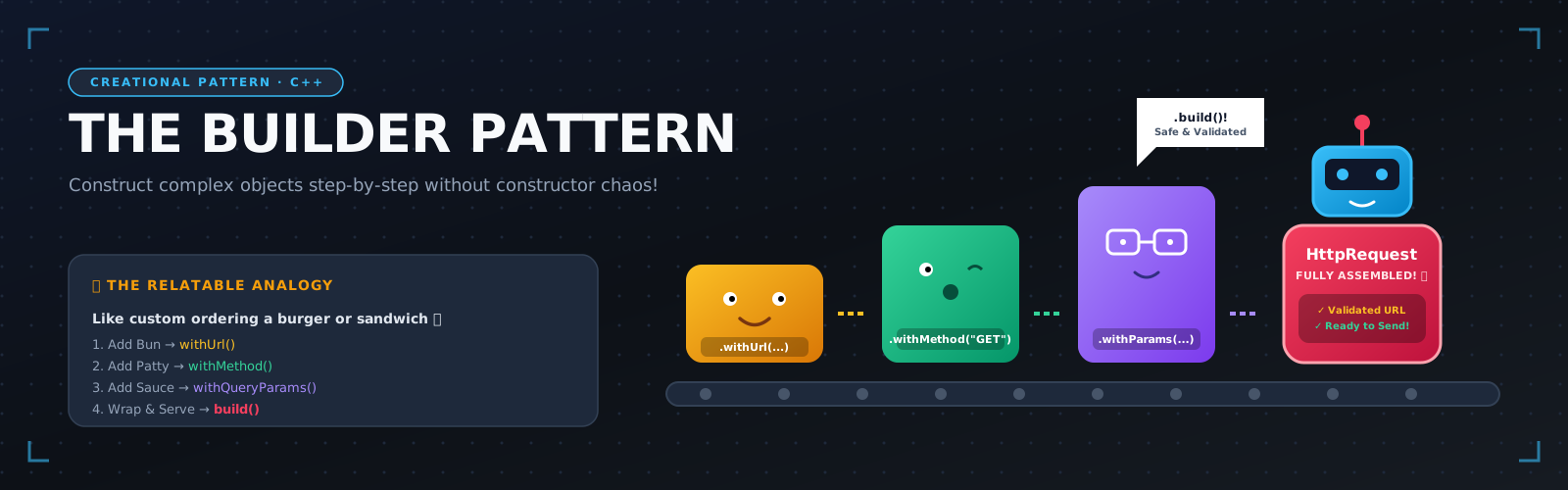
Ever tried to create an object that needs lots of configuration and ended up with long constructors, or worse — inconsistent objects? The Builder pattern gives you a clean, readable, and safe way to assemble complex objects step-by-step.
Here’s a tiny, baby-friendly explanation before we dive in:
- Imagine building a sandwich. You could shove everything into one giant operation (messy!). Or you can add bread, then spread, then fillings, one clear step at a time. Builders let code do the same for objects.
Why we needed the Builder pattern (real problems it solves):
- Telescoping constructors: As your object grows with optional settings, constructors explode into many overloads like “one-ingredient”, “two-ingredient”, “three-ingredient” constructors — hard to read and maintain.
- Inconsistent state: When you use many setters or long constructors, it’s easy to forget a required field and create an object in a bad state.
- Scattered validation: Validation logic sprinkled across constructors or setters leads to duplication and fragile checks.
The Builder pattern centralizes construction, makes intent explicit, and keeps validation in one place.
The Idea (short)
Builder separates the construction of a complex object from its representation. The builder exposes chainable methods for each option and a final build() method that validates and returns the finished object.
Benefits at a glance:
- Fluent, readable code (method chaining)
- Single place for validation
- Avoids telescoping constructors
- Can produce immutable or read-only objects after build
Real example — HttpRequestBuilder in C++
Below is the exact C++ example you provided, plus equivalent versions in Java, Python, and JavaScript so you can compare patterns across languages.
#include <iostream>
#include <string>
#include <map>

using namespace std;

class HttpRequestBuilder;

class HttpRequest {
  private:
      string url;
      string method;
      map<string, string> queryParams;
      string body;

      HttpRequest() = default;

      friend class HttpRequestBuilder;

  public:
      void print() const {
          cout << "Method: " << method << "
URL: " << url << "
Params:
";
          for (const auto& pair : queryParams) {
              cout << "  " << pair.first << ": " << pair.second << "
";
          }
      }
};

class HttpRequestBuilder {
  private:
      HttpRequest req;

  public:
      HttpRequestBuilder& withUrl(string url) {
          req.url = url;
          return *this;
      }

      HttpRequestBuilder& withMethod(string method) {
          req.method = method;
          return *this;
      }

      HttpRequestBuilder& withQueryParams(map<string, string> queryParams) {
          req.queryParams = queryParams;
          return *this;
      }

      HttpRequestBuilder& withBody(string body) {
          req.body = body;
          return *this;
      }

      HttpRequest build() {
          if (req.url == "") {
              throw runtime_error("Url is invalid, can't make http request");
          }
          return req;
      }
};

int main() {
  try {
      HttpRequestBuilder builder;

      HttpRequest req = builder
          .withUrl("https://avinashvarpeti.com/")
          .withMethod("GET")
          .withQueryParams({{"type", "application/json"}})
          .build();

      req.print();

  } catch (const exception& e) {
      cerr << "Error: " << e.what() << endl;
  }

  return 0;
}public final class HttpRequest {
private final String url;
private final String method;
private final Map<String, String> queryParams;
private final String body;
private HttpRequest(Builder b) {
this.url = b.url;
this.method = b.method;
this.queryParams = b.queryParams;
this.body = b.body;
}
public static class Builder {
private String url = "";
private String method = "GET";
private Map<String,String> queryParams = new HashMap<>();
private String body = "";
public Builder withUrl(String url) { this.url = url; return this; }
public Builder withMethod(String method) { this.method = method; return this; }
public Builder withQueryParams(Map<String,String> qp) { this.queryParams = qp; return this; }
public Builder withBody(String b) { this.body = b; return this; }
public HttpRequest build() {
if (url.isEmpty()) throw new IllegalStateException("url required");
return new HttpRequest(this);
}
}
}class HttpRequest:
def __init__(self, url, method='GET', query_params=None, body=''):
self.url = url
self.method = method
self.query_params = query_params or {}
self.body = body
class HttpRequestBuilder:
def __init__(self):
self._url = ''
self._method = 'GET'
self._query_params = {}
self._body = ''
def with_url(self, url):
self._url = url
return self
def with_method(self, method):
self._method = method
return self
def with_query_params(self, qp):
self._query_params = qp
return self
def with_body(self, body):
self._body = body
return self
def build(self):
if not self._url:
raise ValueError('url required')
return HttpRequest(self._url, self._method, self._query_params, self._body)class HttpRequest {
constructor({ url, method = 'GET', queryParams = {}, body = '' }) {
this.url = url;
this.method = method;
this.queryParams = queryParams;
this.body = body;
}
}
class HttpRequestBuilder {
constructor() {
this.req = {};
}
withUrl(url) { this.req.url = url; return this; }
withMethod(method) { this.req.method = method; return this; }
withQueryParams(qp) { this.req.queryParams = qp; return this; }
withBody(body) { this.req.body = body; return this; }
build() {
if (!this.req.url) throw new Error('url required');
return new HttpRequest(this.req);
}
}Walkthrough (baby → pro)
-
Baby level: Builders let you “add ingredients one by one” and finally say “done”. No huge confusing constructors.
-
Developer level: Your builder collects all required and optional configuration, centralizes validation in
build(), and returns a consistent object. -
Production level: Builders enable immutability, thread-safety (if you produce immutable objects), and clearer APIs for clients.
Where to validate?
- Do required-field checks in
build()so callers get a clear exception early. - Validate cross-field rules there too (e.g.,
if method == 'POST' && body.empty() -> warn or error).
Tips & trade-offs
- Use
constorfinalfields in the produced object when possible to prevent later mutations. - Avoid keeping mutable shared state between builder instances.
- Consider providing sensible defaults in the builder so callers only set what matters.
Conclusion
The Builder pattern is a small investment that pays off when objects grow in complexity. It replaces messy constructors, prevents inconsistent state, and centralizes validation — making APIs easier to read and safer to use.
If you want, I can:
- Add compile/run instructions for the C++ example.
- Convert this blog into your existing MDX blog layout (add schema.org JSON-LD or OpenGraph tags).
Would you like me to commit this file and run a local build to verify?